Sports Technology · Enterprise AI

AI at the FIFA World Cup 2026: What's Actually Running Behind the Matches

From a 10 cm offside threshold to digital twins of 16 stadiums, every AI system deployed at the world's biggest football tournament, and what each one tells us about where AI is headed.

Semi-Automated Officiating Football AI Pro Digital Twin Operations Human-AI Decision Loop
AI at FIFA World Cup 2026
The Scale Problem

48 Teams, 104 Matches, 16 Stadiums, Managing This Without AI Is No Longer Possible

The FIFA World Cup 2026 is the largest football tournament ever held. More teams, more venues spread across three countries, more matches running in parallel, and millions of fans, officials, broadcasters, and operators generating a constant flow of data and decisions.

Managing this complexity manually stopped being realistic years ago. What AI enables at this scale: process information faster than any human team can, surface patterns in data that would otherwise take days to find, and reduce the lag between observation and decision.

The most interesting thing about AI at this World Cup isn't that it's being used. It's what it's been designed to do, and what it's been deliberately kept out of.

Every major AI deployment at this tournament follows one design principle: AI produces the evidence and the speed. A human makes the final call. That pattern holds across officiating, coaching, operations, and broadcasting.
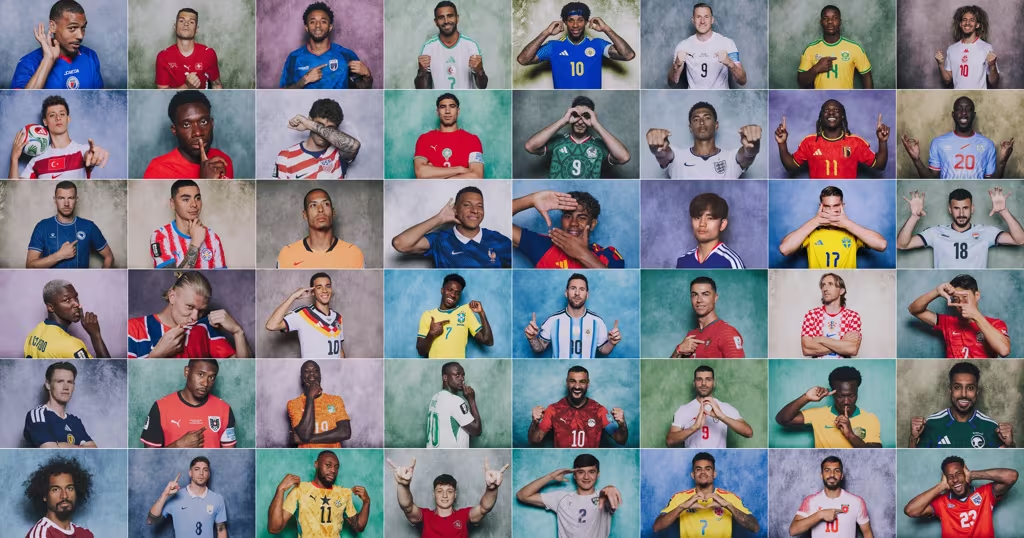
Teams 48 Largest field in World Cup history, up from 32 at Qatar 2022
Matches 104 Every one with AI systems active across officiating, analytics, and broadcast
Host Stadiums 16 Across USA, Canada, and Mexico, all running digital twin monitoring
Global Viewers 5B+ Reached via AI-optimised broadcast infrastructure holding latency under 5 seconds
FIFA World Cup 2026 AI operations overview across 16 stadiums

AI systems are active across all 16 World Cup venues, from pitch-level officiating to crowd management and global broadcast delivery.

Officiating
Alert Threshold 10 cm Down from 50 cm at Qatar 2022, tightest margin ever used in a major tournament
Players Scanned 1,248 Every squad member digitally scanned before the tournament, one second, full body
Alert Route Direct Goes straight to the linesman's earpiece, no video booth stop. Flag raised in real time.
Fan Visibility Live 3D avatar reconstruction broadcast to viewers immediately so every call is legible, not just fast

How FIFA Reduced the Offside Call from 70 Seconds to Under One, and Made It Explainable

Before a single ball was kicked, every one of the 1,248 players at this tournament was digitally scanned, one second, full body, and converted into an AI-rendered 3D avatar. That avatar now drives the offside decision, not the camera feed.

FIFA tightened the automatic-alert threshold from 50 cm at Qatar 2022 to 10 cm this year. The alert no longer routes through the video booth first, it goes directly to the linesman's earpiece while the play is still live.

The avatar isn't just about accuracy. It's broadcast to fans so the call is legible, not just fast, explainable. That's a design choice most AI deployments skip.

The SAOT also now accounts for line-of-sight geometry, whether a player's body blocks the goalkeeper's view, a genuinely hard 3D problem that previous systems couldn't resolve.

Team Intelligence

Football AI Pro Gives All 48 Teams the Same Tactical Intelligence, Not Just the Ones Who Can Afford It

The gap between well-funded squads with bespoke analytics and everyone else used to be structural. This tournament is the first time that gap has been systematically closed.

Football AI Pro A Custom Football Language Model for Every Squad
FIFA and Lenovo built Football AI Pro on a football-specific language model, trained on the vocabulary, patterns, and structure of the game itself. Every one of the 48 teams has access to it, not just the ones with the biggest budgets. Coaches query it in plain language before and after matches. It returns tactical breakdowns, video clips, or 3D visualisations built from hundreds of millions of data points per game. → Smaller federations now operate on the same analytical infrastructure as the top seeds. Tactics is no longer a resource game.
Gemini Partnerships Argentina's Kit Has a Gemini Logo. Their Coaching Staff Is Actually Using It.
Argentina and France both carry Google Gemini at the top sponsorship tier. That part is commercial. The part that isn't: their technical staff uses it for injury prevention, opponent breakdowns, and decision support during training cycles. This runs in parallel with Football AI Pro, one is bespoke and sponsor-driven for two teams, the other is a shared platform across all 48. Both run simultaneously at the same tournament. → Two parallel models of AI access, bespoke and shared, in the same competition. Which produces better outcomes will answer itself by the final.
Knockout Prep Single Elimination Changes What Fast Intelligence Is Worth
Group stage tells you who's good. Knockouts are where AI tells you how to beat them. With three days between matches in the round of 32, the speed of opponent analysis directly affects what walks onto the pitch. Football AI Pro's natural-language interface was built for exactly this turnaround. Ask the question in plain English, get a breakdown with supporting video clips. No analyst required as intermediary. → In group stage, slow analysis costs you position. In knockouts, it costs you the tournament.
Officiating Layer 2

Referee View: Body Cams and Real-Time AI Stabilisation Are Now Standard on the Pitch

Officiating AI at this World Cup isn't limited to offside detection. Referees now wear body cameras with AI-powered motion stabilisation, removing blur from fast-movement footage in real time to produce usable video evidence of incidents that previously existed only in contested memory.

The system, trialed at the 2025 Club World Cup and now standard across all 104 matches, gives the VAR team a first-person view from the referee's position, a vantage point that camera rigs can't replicate.

AI flags the incident. The referee owns the decision, especially on judgment calls like "interfering with play," which remain deliberately outside automated scope.

The design pattern, AI generates the evidence, a person holds the decision, is the same one worth copying in any deployment where outcomes carry consequences.

Technology Referee View Body cam footage with AI motion-blur removal, first trialed at Club World Cup 2025
VAR Integration First-person Gives officials the referee's exact vantage point, not just broadcast angles
Judgment Calls Human Subjective decisions like "interfering with play" remain outside automated scope by design
Operations
Digital Twins 16 One live virtual model per stadium, continuously updated, used for crowd movement prediction
Command Centre Central Single FIFA Intelligence Command Centre aggregating data from every venue and broadcaster in real time
Broadcast Latency < 5 sec AI-driven IPTV infrastructure, a fan in Chennai and a fan in Toronto react to the same goal together

The AI Running 16 Stadium Digital Twins Is the Most Important System No Fan Will Ever See

Digital twins of all 16 host stadiums, live virtual models continuously updated with real-world sensor data, simulate crowd movement and flag congestion risk before it becomes a safety incident.

That data feeds into FIFA's Intelligence Command Centre: a single operational hub pulling live information from every venue, broadcaster, and operations team across three countries simultaneously.

Nobody posts a reel about crowd flow prediction. But this is closer to what genuinely useful AI looks like, infrastructure you only notice when it's missing.

AI-driven broadcast infrastructure has held IPTV latency under five seconds across the entire tournament. That's the unglamorous reason global viewing feels synchronised.
FIFA Intelligence Command Centre digital twin stadium operations monitoring

FIFA's Intelligence Command Centre monitors all 16 venues in real time, powered by digital twins that model crowd dynamics before problems reach the pitch.

Fan Experience

Google's Fan AI Moved from Scores on a Lock Screen to Personalised Match Narratives, Here's What Stuck

Google's consumer-facing AI layer covers live match scores on lock screens, AI-generated visual summaries, personalised content like jersey photo templates, and match highlight reels built automatically from broadcast footage.

The honest read six weeks in: lock-screen scores and AI-generated match recaps have genuine utility, they surface what people actually want faster than searching for it. The novelty-driven features got traction early and faded.

Features that survive on novelty fade before the group stage ends. Anything still being used at the final tells you where AI actually fits in the fan experience.

The durable ones share one trait: they deliver a specific piece of information faster than the alternative.

Lock Screen Scores Durable Live scores surfaced by Google AI, faster than opening an app, genuinely useful throughout the tournament
Match Recaps Durable AI-generated highlight summaries and visual match breakdowns with real post-match utility
Jersey Templates Novelty High engagement in week one, usage dropped sharply once the newness wore off
The Design Pattern

Referees Still Blow the Whistle. Coaches Still Pick the Team. AI Proposes, Humans Decide.

The most persistent misconception about AI in football, and in enterprise, is that it replaces the decision-maker. The World Cup demonstrates the opposite across every deployment at this tournament.

Referees make the final call on every incident. Coaches decide the tactical shape. Security teams determine operational responses. AI compresses the time between observation and decision.

In every durable use case at this tournament, the human is still in the loop, not as a formality, as the actual decision-maker, equipped with better information.

This is the human-in-the-loop model working at scale, the same model that holds up in legal, medical, financial, and operational AI contexts.

Human + AI Model How Every Decision Works
AI Provides Speed Instant pattern recognition across millions of data points per match
Human Provides Judgment Contextual authority, rules interpretation, and final accountability
AI Provides Evidence 3D reconstructions, video clips, risk flags, and tactical breakdowns
Human Provides Expertise Domain knowledge that no current model can replicate or override
Report Card

Which AI Systems Delivered, and Which Were a Press Release

Three days from the final, a clear picture has emerged. The AI that held up was built to accelerate a decision a human still makes. The AI that didn't was built around novelty.

Officiating · Durable SAOT + 3D Avatars Structural and trusted. Faster decisions, fewer controversies, a transparency layer fans can see. The most visible AI at the tournament, and the one that changed how officiating works permanently.
Analytics · Durable Football AI Pro Used by all 48 teams from group stage through knockouts. Plain-language queries returning match intelligence at turnaround speed. Adoption held because it's faster than the alternative.
Operations · Durable Digital Twins + Command Centre Invisible and essential. Crowd modelling, broadcast latency, multi-venue coordination, the AI nobody sees is the AI keeping 16 stadiums running without incident across six weeks.
~ Fan Layer · Mixed Google Fan AI Features Lock-screen scores and match recaps are genuinely useful and still in use. Jersey templates had a strong week one and faded. The durable ones do one thing faster than the alternative.

Six Weeks. 104 Matches. Here's What the World Cup Actually Taught Us About AI.

Every durable AI deployment at this tournament follows the same architecture. AI produces evidence and recommendations fast. A human makes the final call. That pattern held under six weeks of global scrutiny at the biggest sporting event on earth.

The lesson isn't that AI is impressive. It's that AI designed to help humans decide faster is the version that survives real conditions. The systems built around novelty faded by the knockout round.

That's not a football insight. It's a template for how AI should be deployed anywhere decisions have consequences, which is everywhere.